Media
CHATGPT ADS ARE HERE. WHAT ARE WE LEARNING FROM EARLY CAMPAIGNS?
ChatGPT Ads have arrived in the UK, giving brands a new way to reach people while they are actively researching, comparing and considering their options.
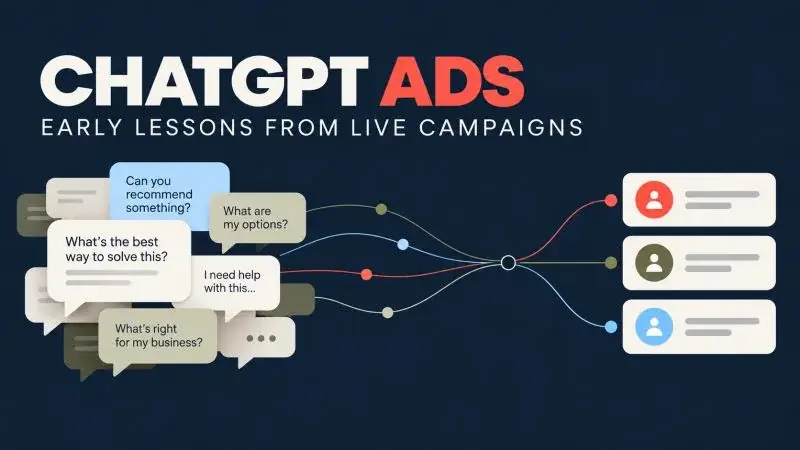
At TENTEN, we have started testing the opportunity through early campaign activity. It is still a developing platform and the volumes are not yet comparable with Google or Meta, but we are already seeing encouraging signs, particularly in the quality and intent of the leads being generated.
Our current view is that ChatGPT Ads are not ready to replace established performance channels, but they are creating a valuable new opportunity within the customer journey.
For brands, the priority now is to understand that opportunity, test it responsibly and begin building knowledge before the market becomes crowded.
Why ChatGPT Ads matter
Search behaviour is evolving.
Consumers are increasingly using large language models such as ChatGPT to explore ideas, understand unfamiliar categories, compare options and narrow down decisions.
This is not simply a change in where people search. It is a change in how they express what they need.
Traditional search often begins with a short keyword or phrase. In ChatGPT, people can describe their circumstances, objectives, preferences and constraints in much greater detail.
A prospective homebuyer might ask:
“Where can I buy a family home with good schools, green space and a commute of less than an hour into central London?”
A business decision-maker could ask:
“What should I consider when choosing flexible office space for a growing team?”
These conversations reveal much more than a keyword. They show the user’s intent, priorities and the context surrounding a potential purchase.
That makes ChatGPT particularly relevant during discovery and consideration, when people are deciding what matters and which brands or solutions deserve closer attention.
What are ChatGPT Ads?
ChatGPT Ads allow brands to place clearly labelled advertising alongside relevant conversations.
The advertisement is separate from ChatGPT’s answer and does not influence which brands or products the platform recommends organically. However, it gives an advertiser an opportunity to appear when someone is actively exploring a related need.
That distinction is important.
ChatGPT Ads are not a shortcut to achieving organic visibility within AI-generated answers. Paid activity and organic AI visibility are separate, although both should be considered as part of a joined-up strategy.
Paid advertising can create an immediate presence around commercially valuable areas of intent. Meanwhile, strong content, structured product information and broader brand authority can improve how clearly AI platforms understand the business over time.
What we have learned so far
The platform is still in beta, so it would be premature to make sweeping claims about its long-term performance. However, several useful patterns are already emerging from early activation.
1. The volume is limited, but lead quality can be strong
ChatGPT is not yet generating the volume of traffic or conversions that advertisers expect from Google or Meta.
What has been more interesting is the apparent quality of the early responses.
People using ChatGPT are often researching a specific question or working through a genuine decision. When the advertising is closely aligned with that conversation, the resulting enquiry can carry a stronger level of context and intent.
For advertisers, that means lead quality may be a more useful early indicator than lead volume alone.
A smaller number of relevant, engaged enquiries can be more commercially valuable than a larger number of poorly qualified leads. This will vary by brand and category, but it is one of the most encouraging signals from our early work.
2. ChatGPT is not replacing Google
Google remains the more mature search and conversion channel.
It offers scale, established optimisation, sophisticated reporting and years of performance data. ChatGPT Ads do not currently provide an equivalent level of volume, control or reporting granularity.
The two channels also play different roles.
Google frequently captures demand once someone knows what they are searching for. ChatGPT can become involved earlier, helping someone articulate a need, understand a category and evaluate possible solutions.
We therefore see ChatGPT Ads as complementary to paid search, rather than as a direct replacement.
3. There is an early-adopter premium
New advertising platforms rarely begin as their most efficient selves.
Inventory is still developing, optimisation has had less time to learn and reliable category benchmarks remain limited. Advertisers should expect some degree of early-adopter premium while the platform matures.
This makes disciplined testing essential. Brands should avoid transferring significant budgets away from proven channels without evidence, but they should also recognise the value of beginning to learn while the opportunity is relatively new.
4. Conversational advertising needs different creative
Copy written for paid search will not necessarily work in ChatGPT.
In a conversational environment, the advertising needs to feel useful, contextual and relevant to what the person is trying to achieve. It should help the user take the next step rather than simply repeat a promotional message.
The language can still be persuasive and commercial, but it should feel appropriate to the platform.
As with every media channel, effective advertising respects the environment in which it appears.
5. Intent matters more than keywords
ChatGPT Ads require advertisers to think beyond conventional keyword lists.
The more useful planning question is not simply, “Which terms might somebody search?” It is, “Which situations, questions and decisions indicate that somebody may need this product or service?”
This creates a shift from keyword matching towards intent and situational mapping.
For example, a property advertiser might explore conversations around:
- Moving to a particular area
- Commuting requirements
- Schools and family life
- Downsizing
- Investment potential
- Affordability and mortgage considerations
- Comparisons between different locations
Each territory represents a need or decision, not merely a search term.
6. Campaign structure is critical
Reporting remains less granular than advertisers may be accustomed to within paid search.
There is not always the same level of query or keyword-level information, making it harder to separate the performance of individual terms.
Campaigns therefore need clean segmentation from the outset. Different topics, audiences, messages and areas of intent should be separated into logical ad groups so that useful conclusions can still be drawn.
Poorly structured testing will produce activity. Well-structured testing will produce learning.
How should brands approach ChatGPT Ads?
We recommend beginning with four strategic questions.
1. Where does the business need to win?
Start with the commercial priority.
Which product, service, audience or market matters most? What business problem could this activity help to solve?
The fact that a new advertising platform is available is not, by itself, a reason to use it.
2. Which questions shape the decision?
Identify the questions customers ask while researching the category.
What are they trying to understand? What prevents them from making a decision? Which comparisons do they make? What personal or practical circumstances shape their choice?
These are the high-value intent territories in which the brand may want to be present.
3. How visible is the brand across AI platforms today?
Audit the brand’s organic AI visibility.
Does it appear when people ask relevant questions? Is the information accurate? Which competitors are being mentioned? Where are the most commercially important gaps?
Paid advertising will not change the contents of ChatGPT’s answers, but understanding organic visibility helps the business see the complete AI discovery landscape.
4. Where can paid activity add immediate value?
Once the commercial priorities and visibility gaps are understood, identify the areas where paid advertising could create a useful and timely presence.
The strongest opportunities are likely to sit where customer intent, business priority and a relevant proposition overlap.
Six practical steps brands can take now
1. Audit current AI visibility
Establish a benchmark for how often and how accurately the brand appears across important AI-led conversations.
This should include competitor comparisons and an assessment of the sources that appear to inform those answers.
2. Define success before launching
Agree what the campaign is intended to achieve.
Measures could include qualified enquiries, engaged website visits, assisted conversions, direct sales or improvements in cost per qualified lead.
For early campaigns, lead quality and commercial relevance may matter more than raw scale.
3. Make content and product information AI-readable
AI platforms need clear, accurate and structured information.
Brands should review website copy, product feeds and schema markup to ensure their proposition can be interpreted correctly. Important details should not be hidden inside images, vague marketing language or incomplete product descriptions.
4. Reserve a flexible testing budget
Create space within the wider media plan for controlled experimentation.
The budget should be large enough to produce meaningful signals without placing proven performance activity at risk.
5. Commit to a structured test
A short burst of activity may not provide enough information to judge the opportunity properly.
A 60-day testing programme gives the campaign more time to gather data, evaluate different intent territories and assess the quality of the resulting traffic and enquiries.
It also allows advertisers to compare the results with established Google, Meta and paid-search benchmarks.
6. Establish what success looks like
This is perhaps the most important lesson.
A new platform can easily attract attention simply because it is new. That is not a media strategy.
Before launching, advertisers need to determine what they are trying to learn and what evidence would justify further investment.
That could mean:
- Generating a defined number of qualified enquiries
- Reaching people within a high-value area of consideration
- Understanding which intent territories produce the best response
- Comparing lead quality with established channels
- Testing whether conversational creative improves engagement
- Establishing an initial cost-per-lead benchmark
Success should be defined in commercial terms, not simply through impressions or clicks.
Our view
ChatGPT Ads remain an emerging proposition. The platform is not yet as mature, scalable or measurable as Google or Meta.
However, our early experience suggests that it deserves serious attention. While volumes are currently smaller, the quality and intent behind the resulting leads can be encouraging.
The opportunity is not to omit established channels in pursuit of the latest development. It is to understand how conversational discovery is changing the customer journey and begin building practical experience.
Brands that test thoughtfully now will be better placed to understand the language customers use, the questions that shape decisions and the role conversational platforms can play in generating future demand.
ChatGPT Ads may still be in their infancy, but the shift towards conversational discovery is already under way.